President Ahmed al-Sharaa told investors in Riyadh that Syria “chose the path of reconstruction through investment” rather than aid. 1 Around Damascus, that choice now meets residents who lost homes in the war or land decades ago, and who ask who will pay. This dossier sets out two cases, the officials responsible and what they say.
Eastern Damascus: Jobar and al-Qaboun
Supported by independent sources
In March 2026 officials of the Damascus Governorate, headed by Maher Marwan, presented a plan for unnamed foreign companies to rebuild 1,100 hectares of Jobar, al-Qaboun and Bab Sharqi in exchange for about half the land. Owners would keep 50 percent of zoned residential property and 30 percent of land classified as agricultural, which includes large areas of informal housing. No investors, contracts, zoning plans or valuation mechanisms were published. 1
Marwan argued in April that grants were unavailable, foreign loans blocked and owner-led rebuilding too slow; al-Qaboun residents called the plan “real estate expropriation” and asked for the 2015 urban planning law, with its valuation committees and court appeals, to apply. 1
West of Damascus: Abyat Hills and Sham View
Supported by independent sources
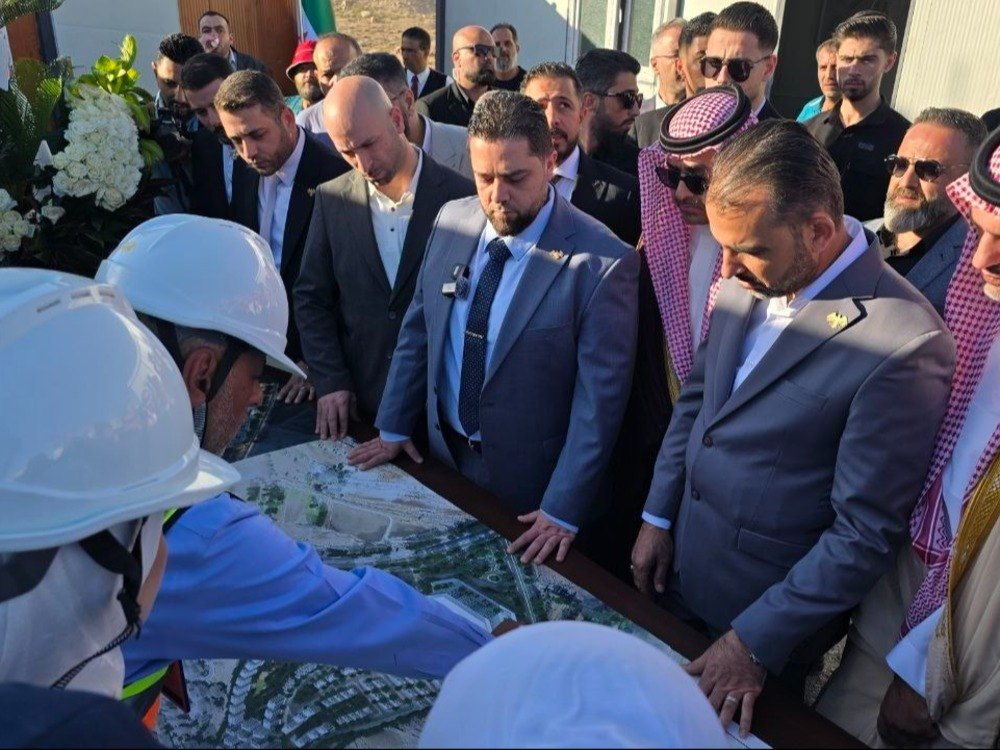
- Abyat Hills: about 2,000 homes on some 380,000 square metres in Qudsaya suburb, by the Saudi company Abyat and the state General Housing Establishment. Minister of Public Works and Housing Mustafa Abdel Razzaq laid the foundation stone on 6 June 2026 and said the deal was signed under al-Sharaa’s patronage. 2 3
- Sham View: more than 10,000 units on 178 hectares between Qudsaya and Dummar, by the Saudi company Thra and the General Housing Establishment, launched in August 2026; the first 2,000 units opened for subscription on 22 September. 4 5
- Abyat is also developing a project of about 20,000 units in al-Bajaa; investment in its two projects is reported at more than $2 billion. 5
The protests
Supported by independent sources
On 26 and 27 September 2026 residents of Qudsaya, Dummar, al-Bajaa, Moadamiya and other towns marched on the offices of both projects, stopped machinery at Sham View and blocked access for staff. They demanded that work halt, that the expropriation decisions be reviewed and that compensation and ownership be settled before construction continues. 5 6 7
The protesters say the land was expropriated under the former government for public purposes and is now being handed to private investment, while owners received little or nothing. 5 7
What the authorities and the developers say
Supported by independent sources
- The Ministry of Public Works and Housing said in a statement posted on Facebook late on 28 September that expropriation is a lawful tool, that most of the decisions date back decades and compensation was deposited and partly paid, that an objection does not return ownership automatically, and that stopping machinery or blocking roads creates no legal title. It announced a joint complaints office with the Rural Damascus governorate. 8 9
- The fact-checking platform Verify-Sy reviewed 377 comments under the ministry’s Facebook statement. Opposing comments initially outnumbered supportive ones 209 to 62; then, on the evening of 29 September, 30 accounts posted supportive comments within about 18 minutes, and 17 identical texts appeared across 57 accounts, some calling owners’ claims “fictitious”. Of the accounts in that burst, 19 had been created between late August and late September 2026. Verify-Sy says the pattern indicates coordination but does not identify who ran it. 9
- The minister discussed the complaints with Rural Damascus governor Amer al-Sheikh on 28 September. 10
- Tamam al-Dabal, director-general of the General Housing Establishment, said compensation under the 1983 expropriation law is set at the land’s value before the decree, leaving a large gap with today’s prices. Of about 3,905 requests for in-kind compensation filed between 1997 and 2008, 730 were processed; applications would reopen. 7
- Abyat said it is an investor and developer, not a party to the ownership dispute, that claimants should go to the courts, and that it would continue the project and take measures to protect the site and its workers. 7
Beyond Damascus
On 28 September residents of al-Qarabis in Homs protested outside the governorate over expropriated land linked to the “Boulevard” project. 11 TIMEP also points to a revived redevelopment plan in Aleppo’s Haydariyyah and eviction notices to farmers in al-Bajaa. 1 Writing on A People’s Planet, analyst Alex Simon argues that Western governments which denounced Assad-era expropriation schemes have been publicly silent as similar projects continue. 12
What this does and does not establish
The record shows the transitional authorities advancing investor-led projects that rely on owners’ land, through proposed deductions from their property in eastern Damascus and through expropriations carried out under previous governments west of the capital, without published valuations; the government’s own figures show that most requests for in-kind compensation filed between 1997 and 2008 were not processed. The ministry says the procedures are lawful and has opened a complaints channel. No court has ruled the projects unlawful, and we do not allege that any official personally profited. Verify-Sy did not identify who coordinated the supportive comments, and we do not attribute them to the ministry or the minister. 1 7 8
Profile: Mustafa Abdel Razzaq · Profile: Maher Marwan · Iktifaa and the land of displaced families in Hama
People in this article


Sources
- Press Who Pays for Syria’s Reconstruction? Residents Push Back on Investor-Led Projects in Eastern Damascus — TIMEP — Jad Baghdadi, August 27, 2026
- Press More than 2,000 housing units: launch of the Abyat Hills project in Qudsaya suburb (Arabic) — Al-Thawra, June 7, 2026
- Press Minister of Public Works and Housing: the Abyat Hills project is an important step in urban development (Arabic) — Al-Ikhbariya, June 7, 2026
- Press Saudi Firm Launches ‘Cham View’ in Damascus: Syria’s Largest Residential Project — The Syrian Observer (citing SANA), August 26, 2026
- Press Real Estate Projects in the Crosshairs of Protests – Who Will Settle the Expropriated Land File? — The Syrian Observer, September 29, 2026
- Press Qudsaya residents halt “Sham View” project over expropriation file — ANHA (Hawar News), September 26, 2026
- Press Syria’s General Housing Establishment moves to compensate owners of expropriated land (Arabic) — Al Jazeera, September 28, 2026
- Press Ministry of Public Works responds to the controversy over expropriated land (Arabic) — Aks Alser, September 29, 2026
- Press Identical wording and new accounts: how support for the land expropriation statement was engineered (Arabic) — Verify-Sy, October 5, 2026
- Press Minister of Public Works and Rural Damascus governor discuss demands of those affected by expropriation decisions (Arabic) — Al-Ikhbariya, September 28, 2026
- Press Syria: does the legacy of expropriation threaten reconstruction projects? (Arabic) — Al Jazeera, October 2, 2026
- Press Syria, self-made: The fight against expropriation — A People's Planet — Alex Simon (opinion), October 1, 2026