Appointment
Supported by independent sources
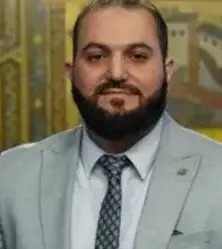
Maher Marwan was appointed Governor of Damascus on 15 December 2024, a week after the fall of Bashar al-Assad’s government, by the caretaker government then headed by Mohammad al-Bashir. 1 2 According to Al-Mashhad, he was born in Damascus, holds a degree in Islamic Sharia, worked for about ten years in business administration and moved to Idlib early in the conflict after being pursued by the Assad government’s security services. 1
In an interview with NPR in December 2024 he said the new authorities did not fear Israel and did not want to threaten its security or that of any other country; after the remarks caused controversy, he said they concerned internal peace rather than foreign relations. 3 1
Reconstruction of eastern Damascus
Supported by independent sources
In March 2026 officials of the Damascus Governorate he heads presented, at a closed meeting of about 30 residents’ representatives, lawyers and engineers, a plan under which unnamed foreign companies would finance and rebuild 1,100 hectares of eastern Damascus, covering Jobar, al-Qaboun and Bab Sharqi, in exchange for roughly half of the land. Officials put the cost at $21 billion and promised some 200,000 jobs, but no investors, contracts, zoning plans or valuation and compensation mechanisms were published. 4
Under the plan, owners would receive only 50 percent of the area of zoned residential property and 30 percent of land classified as agricultural, a category that also covers large areas of informal housing. At a dialogue session in April, Marwan argued that grants were unavailable, foreign loans were blocked and owner-led rebuilding was too slow and costly, presenting investment as the only realistic path. 4
Residents of al-Qaboun called the project “real estate expropriation” and asked for Urban Planning Law No. 23 of 2015, which offers valuation committees and recourse to the courts, to apply instead; Jobar’s residents’ board rejected the compensation offered. 4
TIMEP’s analyst describes the deduction from owners’ land as shifting the cost of reconstruction onto war-affected property owners, and notes that the plan echoes Assad-era redevelopment schemes. 4
The Syria Justice and Accountability Centre reports that on 2 June 2026 two residents’ representatives negotiating compensation under Decree 66 of 2012 were detained after the Damascus Governorate filed a complaint against them under the cybercrime law and Assad’s 2011 anti-demonstration decree. 5 More in the dossier on the Hamsho settlement
Family ties to Ahmed al-Sharaa
Supported by independent sources
Al-Monitor reported in February 2025 that the sister of Latifa al-Droubi, al-Sharaa’s wife, is reportedly married to the governor of Damascus. 180Post, citing Syrian sources, reported the same marriage in December 2024 and described him as al-Sharaa’s maternal cousin as well. 6 2 Arabic-language accounts differ on the exact relationship on the mother’s side (son of a maternal aunt or of a maternal uncle). No official statement on the family ties has been published.
Roles in Idlib
According to 180Post, citing unnamed Syrian sources, he was registered in Idlib’s civil records as Maher Idlibi and known as Abu Majid al-Shami. The outlet reports that in Idlib he was part of al-Jolani’s (al-Sharaa’s) escort, a security role, before being appointed a judge at the Sarmada court, then judicial inspector, member of the Supreme Judicial Council, head of the Zakat Authority and member of the advisory council, and that he was given security-related tasks after the killing of HTS’s second-in-command Abu Maria al-Qahtani in 2024. 2 We have not been able to confirm these roles from official records.
Accusations by al-Sharaa’s opponents
Published allegation
180Post reports that opponents of al-Sharaa accuse Marwan, under the name Abu Majid al-Shami, of involvement in corruption and in the torture of detainees during HTS’s 2024 “agents affair”. It cites a document in which a former al-Nusra commander accuses al-Jolani of appointing him a judge without the required qualifications, a letter from the former HTS commander Abu Malik al-Talli urging him to release detainees, and a claim by Hassan Bard, a former HTS member, that he acted as intermediary when al-Jolani paid judges not to join the 2024 protests. 2
These accusations come from al-Sharaa’s political opponents and reach us through a single outlet citing unnamed sources and documents we have not seen. We have not been able to verify them and have found no response from Maher Marwan; they are recorded here as published allegations, not as established facts.
Read about the 2024 “agents affair” · Profile: Ahmed al-Sharaa