What children learn in school shapes how a generation sees its country, its neighbours and its faith. Since December 2024 Syria’s school curriculum has been changed twice: first by a list of amendments issued in January 2025, then through reissued textbooks handed out to pupils in September 2026. This dossier sets out what the books and official statements show, how critics and the ministry describe the changes, and what is not yet known.
January 2025: “for the sake of God”
Supported by independent sources
In early January 2025 the Ministry of Education, then headed by Nazir al-Qadri, published lists of amendments covering every school grade. In Islamic-education books, “that a person gives his soul for his homeland” became “that a person gives his soul for the sake of God”, “governed by the law of justice” became “governed by God’s law”, and “the principle of human brotherhood” became “the principle of brotherhood in faith”. The unit on “the origin of life and evolution” was removed from science, and references to Zenobia, the Arameans and the Canaanites were removed from ancient history. 1 2
AFP reported that the changes also reinterpreted a Quranic verse about those who have “gone astray” as referring to “Jews and Nasara” (Christians), and removed poetry about women and love. 2 On 9 January 2025 Decision 104 abolished the subject of national education. 1
Al-Qadri said the ministry had “only ordered the deletion of parts glorifying the defunct Assad regime” and corrected Quranic verses that had been “explained in the wrong way”, and that the curricula would “remain as is until specialized committees are formed to review and audit” them. 2 In May 2025 Syrians for Truth and Justice (STJ) reported that no such committees had been announced, and called the reform “an ideological unilateral decision lacking legitimacy”, taken without consulting experts and extending to literary and philosophical content with no link to the former regime. 3
October 2025: fewer religion lessons, and a backlash
Supported by independent sources
In October 2025 Arabi21 reported that the new minister, Mohammed Abdul-Rahman Turko, had cut Islamic-education lessons from four to two a week and replaced the subject “The Holy Quran and its Etiquette” with music and the arts. Teachers and pupils protested in Idlib, residents demonstrated in Hama and outside the ministry in Damascus, and preachers campaigned against the decision online. In Hama the instruments of the national music institute were smashed; officials called it “an individual act”, and it was not known whether the attack was linked to the decision. The ministry did not publish an official clarification of the timetable. 4
2026: the reissued textbooks
Supported by independent sources
On 17 August 2026 the ministry announced a single curriculum for all governorates for 2026–2027, based on the previous year’s “Damascus curriculum”. 5 On 14 September Minister Turko told the People’s Assembly that images and symbols of the former regime had been removed from the last two editions of the textbooks and that 41 million books had been printed. 6
The journalist Mohammad al-Salloum then published side-by-side comparisons of old and new editions. The fact-checking platform Verify-Sy (Ta’akad) checked them against older digital editions and against the printed books distributed to pupils for 2026–2027, and confirmed that: 7 8
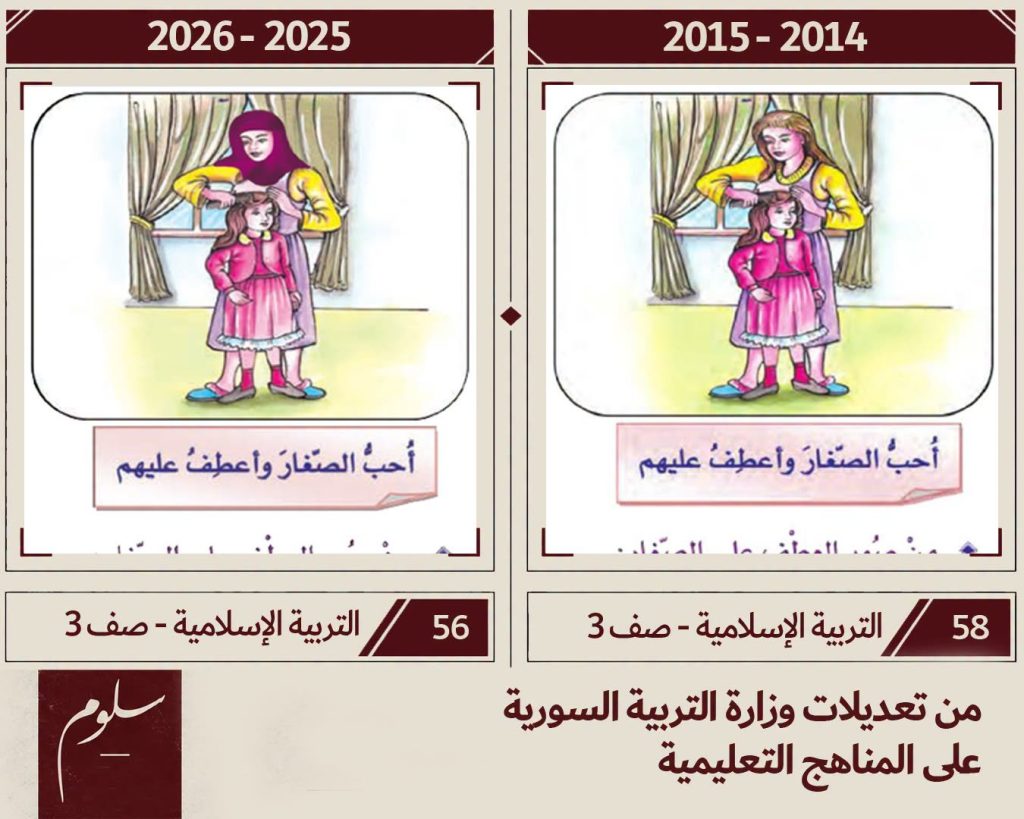
- a drawing of a mother combing her daughter’s hair in the grade 3 Islamic-education book (p. 58 in 2014–2015) now shows her in a hijab (p. 56 in 2025–2026);
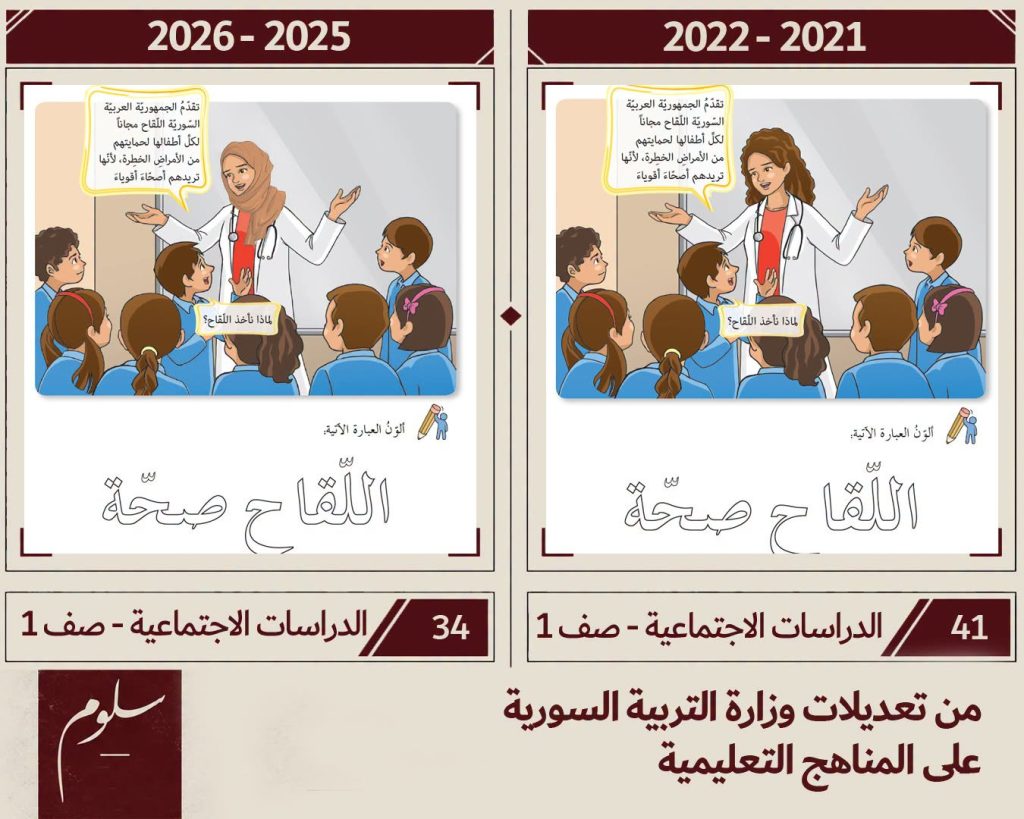
- a female doctor explaining vaccination in the grade 1 social-studies book was given a hijab between the 2021–2022 and 2025–2026 editions — while the same character appears without one on another page;
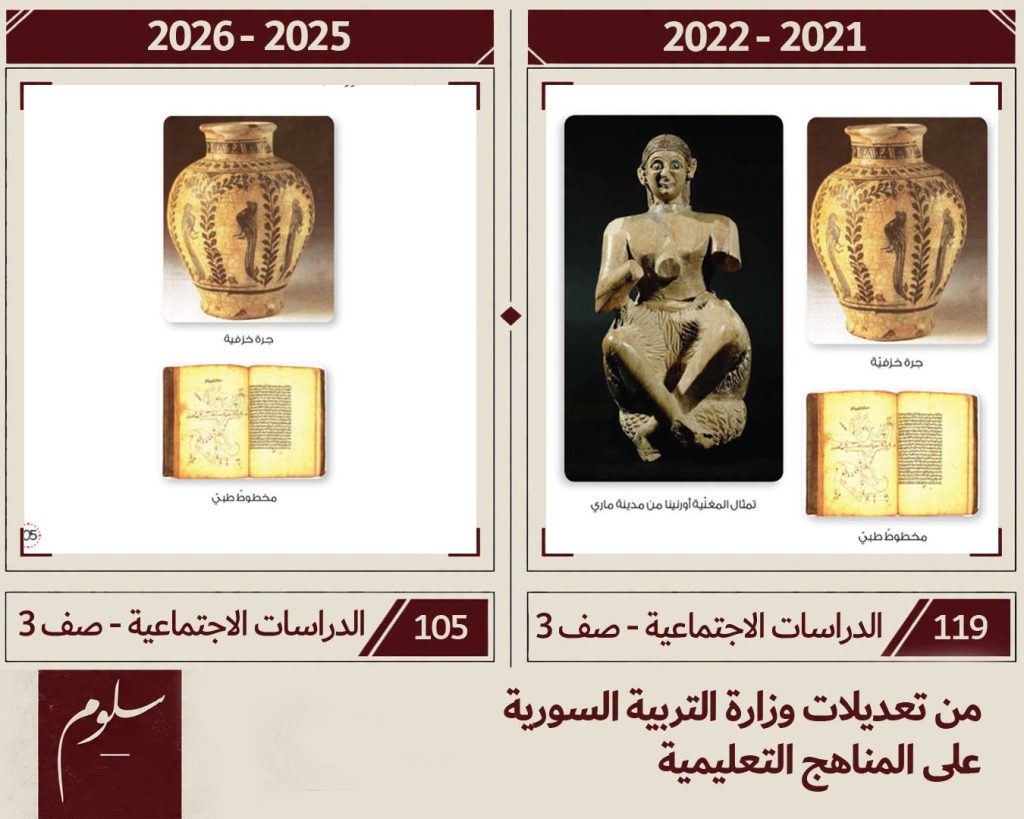
- the statue of the singer Ur-Nanshe (Urnina) from Mari and the statue of a tambourine player from Ugarit were removed from the grade 3 social-studies book, while pictures of a jar, a manuscript, gold earrings and the Ugarit alphabet were kept;
- the ancient Egyptian statue of a seated scribe was given clothing covering his torso in the grade 6 social-studies book;
- the grade 6 social-studies book, first issued in 2012–2013, was reissued without its lessons on local administration, political life, citizenship, the media and democratic participation; 7
- drawings of women were removed or given hijabs — in one case a jilbab — in some early-grade books and a grade 7 book. 7 8
History judged by religious criteria
Published allegation
In a later post, al-Salloum wrote that the most important change was the “religious, sharia-based judgement” of historical periods in the grade 7 and grade 10 history books: a paragraph exposing the “false beliefs” of the Qarmatians was added, and the Fatimid state was renamed the “Ubaydid state”, with sentences about its “misguidance” inserted between passages praising its achievements. He also wrote that texts by Adonis, Suleiman al-Issa, Jamil Sidqi al-Zahawi and Badr Shakir al-Sayyab were removed from the final-year Arabic literature book, and that most books were left untouched while some pages were altered entirely — evidence, in his view, of “random and improvised” editing. 9
The removal of al-Zahawi’s work and of “the origin of life” had already been reported by STJ in May 2025, and IMPACT-se’s review (below) also describes the Fatimid Caliphate as being “delegitimized”. 3 10
Jihad, martyrdom and minorities: IMPACT-se’s analysis
In October 2026 IMPACT-se, an Israel-based organisation that reviews school textbooks, published a 241-page analysis of 130 textbooks for 2025–2026, comparing them with Assad-era editions. It concludes that Ba’athist and Syrian-national narratives “have been substantially replaced by concepts of Islamist political ideology, Sunni Muslim exceptionalism, and pan-Islamist nationhood”, and that the January 2025 directives “predominantly persist”. 10
Published allegation
- “Jihad, martyrdom, and self-sacrifice in battle are presented as central to identity and as legitimate, often desirable, ideals”; sacrifice for “the homeland” becomes sacrifice “for the sake of Allah”, and “resistance fighters” become “jihad fighters”. 10
- Women are “framed mainly as wives and mothers, expected to obey husbands”; revised content on dress “advocates the Salafi-standard full-body-covering burqa’”, and references to Syrian law guaranteeing gender equality were removed. 10
- Kurds, Turkmen and Druze are “almost entirely absent”, Christians are presented as subordinate to Islamic law, and Shi’i and Alawite symbols are “actively contested”; Jews are “generally described in demonizing terms”. 10
- In science, evolution and the Big Bang are deleted or altered, and “Nature’s gift” becomes “Allah’s gift”. 10
Some defenders of the ministry dismissed al-Salloum’s comparisons as relying on an “Israeli” report. 8 The specific textbook changes listed above under 2026 were checked independently by Verify-Sy; IMPACT-se’s broader characterisations are its own. Already in January 2025, the activist Shiyar Khaleal told AFP that “education based on extremist ideologies may shape individuals whose ideas threaten regional and international security”. 2
What the ministry says
In a statement on 26 October 2026 the ministry acknowledged amending the curriculum, limited this to the amendment announced in January 2025, and said it consisted of removing the former regime’s symbols and “ideological content” and correcting related images, in order to preserve diversity and the presence of all components of Syrian society. It called circulating images inaccurate without saying which, and published examples of women without hijabs. It did not explain why hijabs were added or statues removed; one of the images it published is itself the amended version of the grade 3 drawing. The same statement announced a new national curriculum framework, to be applied gradually. 8
A Damascus school’s decision in September 2026 to separate boys and girls in its middle and secondary classes — the former Lycée Laïque — was, according to its administration, taken independently “with no connection to any official body”. 11 “Males only”: who is shut out of Syria’s 2026 university admissions
What this does and does not show
The documents show that the textbooks Syrian children use today replace national with religious language in key passages, add hijabs to some drawings of women, remove ancient statues, evolution and lessons on citizenship and democracy, and that the ministry has acknowledged changing the curriculum without explaining these changes or naming the committees its first minister promised. 7 8 2 3
They do not show a single consistent programme: the changes are uneven within the same books, and in 2025 the ministry also cut religion lessons in favour of music and the arts. 4 9 Nor do they show how teachers teach this material or what effect it has on pupils; no study has yet measured whether it makes young Syrians more radical. The new curricula under the announced framework have not yet been written. We will update this page as they are published.
Sources
- Human-rights organisation Women deleted and others redrawn in Syrian curricula (Arabic) — Syrian Feminist Lobby, October 27, 2026
- Press Syria minister defends school curriculum changes after uproar — AFP (via Courthouse News), January 2, 2025
- Human-rights organisation Syria: Curriculum reform… an ideological unilateral decision lacking legitimacy — Syrians for Truth and Justice (STJ), May 15, 2025
- Press Wide controversy after religious lessons reduced in Syria and replaced with music and arts (Arabic) — Arabi21, October 5, 2025
- Official record Ministry of Education: unified curricula in all governorates for 2026–2027 (Arabic) — SANA, August 17, 2026
- Official record Education Minister before the People’s Assembly: unified curriculum, new national standards, 41 million textbooks (Arabic) — SANA, September 14, 2026
- Press Changes to Syrian curricula include deleted lessons and obscured images of women and artworks (Arabic) — Verify-Sy (تأكد), October 24, 2026
- Press How the Education Ministry’s statement became proof for denying changes it did not deny (Arabic) — Verify-Sy (تأكد), October 26, 2026
- Media Post on the latest batch of curriculum changes: history books, Arabic literature, images of girls (Arabic) — Mohammad al-Salloum (Facebook), October 2026
- Human-rights organisation The New Syria: Education under al-Sharaa — Review of Syria’s national school curriculum 2025–2026 — IMPACT-se, October 19, 2026
- Press Did the Damascus Laïque school separate boys and girls? (Arabic) — Verify-Sy (تأكد), September 2026