Two questions are asked about Syria’s new rulers more than any other: is the country becoming a democracy, and is Ahmed al-Sharaa a dictator? This dossier does not answer with labels. It sets out what the official texts say about how he came to power and what powers he holds, how the People’s Assembly that is meant to check him was formed, and what officials, critics and analysts say about it.
How al-Sharaa became president
Supported by independent sources
On 29 January 2025, at a meeting in Damascus of the commanders of the armed factions that had toppled Bashar al-Assad, the spokesman of the Military Operations Command, Hassan Abdel-Ghani, announced that Ahmed al-Sharaa had been named president for the transitional period. The 2012 constitution was suspended, the armed factions, the former army, the security agencies and the Baath Party were declared dissolved, and al-Sharaa was authorised to form a temporary legislative council. 1
No vote was held. On 13 March 2025 al-Sharaa issued the Constitutional Declaration himself. It sets a five-year transitional period that ends only once a permanent constitution has been adopted and elections held under it, and it provides for no presidential election before then. 2
The president’s powers under the Constitutional Declaration
Supported by independent sources
- He forms the higher committee that selects the members of the People’s Assembly, and appoints one third of the members himself (Article 24). 2
- He appoints and dismisses ministers; the declaration provides for no prime minister (Article 35). 2
- He appoints all seven members of the new Supreme Constitutional Court (Article 47). 2
- He may object to laws passed by the Assembly; it can then pass them only with a two-thirds majority (Article 39). 2
- Only he can propose amendments to the Constitutional Declaration, which then need two thirds of the Assembly (Article 50). 2
- He is supreme commander of the army and armed forces (Article 32) and may declare a state of emergency of up to three months with the approval of the National Security Council (Article 41). 2
- The declaration contains no procedure for the Assembly to remove the president or to withdraw confidence from ministers; it may “hold hearings for ministers” (Article 30). 2
On paper, the declaration also commits the state to a political system “based on the principle of separation of powers” (Article 2) and to an independent judiciary (Article 43), and gives the Assembly the power to propose and approve laws and to approve the state budget (Article 30). 2
How the People’s Assembly was formed
Supported by independent sources
- 13 June 2025 — Decree 66: al-Sharaa formed the Supreme Committee for People’s Assembly Elections, chaired by Mohammed Taha al-Ahmad, and named its ten other members. 3
- 19 August 2025 — Decree 143, the temporary electoral system: the Assembly has 210 members, two thirds of them elected (Article 2). The Supreme Committee appoints a sub-committee in each electoral district (Article 9); each sub-committee chooses the members of its district’s “electoral body” (Article 23) — fifty per seat (Article 5); and only members of these electoral bodies may stand as candidates (Article 26). The results go to the presidency “for review and ratification”, and the president issues the decree containing them together with the names of the third he appoints (Article 38). 4
- The decree asks that women make up “not less than twenty per cent” of the electoral bodies as a whole, to be observed “insofar as possible” (Article 24). 4
- 5 October 2025: around 6,000 members of the electoral bodies voted, choosing among candidates from their own ranks. 5 None of the candidates belonged to a political party; parties had been dissolved earlier in the year. 6
- 6 October 2025: 119 members were declared elected. The vote was postponed in the Kurdish-held north-east and in Suwayda province, leaving 21 seats empty; the authorities cited security and political reasons. 5 7
- May 2026: after an agreement to integrate the Kurdish-led administration’s institutions into the state, representatives were selected for Kurdish-majority areas; several Kurdish parties rejected the outcome, saying those chosen “represent only themselves”. 8 We have found no report that Suwayda’s seats have been filled.
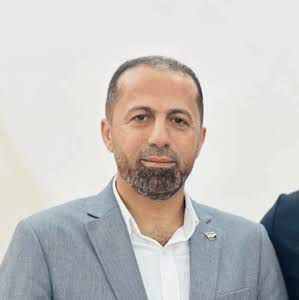
- 1 July 2026: al-Sharaa appointed the remaining 70 members — 55 men and 15 women, according to the Assembly’s secretary-general. 8 Among them were Anas al-Abdah and Nawar Elias Najma, both of whom had been named by Decree 66 to the Supreme Committee that oversaw the selection; Najma had also been the committee’s spokesman. 3 8 9 10
Who was elected
Supported by independent sources
Announcing the results, the Supreme Committee’s spokesman Nawar Najma (spelled Najmeh by AFP) said that only four per cent of the 119 members elected were women — a number “not proportionate to the status of women in Syrian society” — and that only two Christians had been elected, a representation he called “weak considering the proportion of Christians in Syria”. Women had made up 14 per cent of the more than 1,500 candidates. He said that “perhaps the president’s third could compensate”, but rejected any quota system. 7
What the numbers mean
The Assembly has 210 seats, so overriding a presidential objection to a law takes 140 votes. Because the president appoints 70 members, the elected members can reach 140 on their own only if every elected seat is filled and every elected member votes the same way; otherwise some of the president’s own appointees must join them. 2 4
What officials and analysts say
An analysis published by Alpheratz Magazine on 6 October 2026 places the present debate over political parties in a longer historical context. It reports that anti-party arguments resurfaced after the fall of the Assad government, including a statement by presidential media adviser Ahmad Muwafaq Zaidan that “parties, factions and groups disperse the effort of the Syrian state”. It also says that the first draft of the new Assembly’s rules included a ban on political and party blocs before that provision was removed from the rules the Assembly adopted. 11
The Alpheratz analysis argues that Syria’s long authoritarian turn cannot be explained by the weaknesses and divisions of its pre-Baath parties alone. Successive military interventions and rounds of exclusion, it says, progressively stripped parties, newspapers, parliament, trade unions and social networks of the resources through which political losers could reorganise and return. That history is relevant to current claims that party and parliamentary life should be postponed to avoid repeating the earlier republic’s instability; it is an argument by the author, not evidence by itself about how today’s authorities will use their powers. 11
The authorities chose indirect selection rather than universal suffrage, pointing to the lack of reliable population data after a war that killed hundreds of thousands of Syrians and displaced millions. 5 Officials involved in the process told the Italian Institute for International Political Studies (ISPI) that the hybrid, indirect system was “a compromise between aspirations and practical constraints” of the post-war period. 6 Under the Constitutional Declaration the Assembly exercises legislative power until a permanent constitution is adopted. 2
ISPI noted that among the 119 elected members “only six are women, and very few represent the country’s ethnic and religious minorities”, and that al-Sharaa was expected to address the imbalance with his appointments. 6
In an analysis for the Hoover Institution in March 2026, the French geographer Fabrice Balanche called the body “a puppet Parliament” and argued that al-Sharaa’s goal “appears to be the establishment of an authoritarian Islamic republic in Syria”. 12 He also wrote that the Assembly “will only have an advisory role and no legislative power”; the Constitutional Declaration in fact gives it legislative power, within the limits set out above. 2
What this does and does not show
Is Syria a democracy? No national vote of any kind has been held since December 2024. The present parliament was chosen by about 6,000 electors selected through committees formed from the top down, a third of its members were appointed by the president, and no political parties took part. 5 6 8
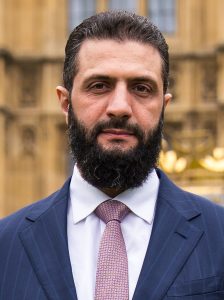
Is al-Sharaa a dictator? We do not use labels. The documents show that al-Sharaa, who was not elected to his office, holds executive and military power; appoints the ministers, the constitutional court and a third of parliament; chose the committee that organised the selection of the rest; can block any law unless two thirds of the Assembly overrule him; and cannot be removed by the Assembly, because the Constitutional Declaration provides no procedure for it. 2 1
The documents do not show how he will use these powers, whether the Assembly will vote against him, or whether the transition will end, as the declaration promises, in a permanent constitution and elections. We will update this page as the Assembly’s record and the electoral timetable become clear.
People in this article
Sources
- Press Syria’s Ahmed al-Sharaa named president for transitional period — Al Jazeera English (citing SANA), January 29, 2025
- Official record Constitutional Declaration of the Syrian Arab Republic (Arabic original; English translation published by ConstitutionNet) — Presidency of the Syrian Arab Republic, March 13, 2025
- Official record Presidential Decree 66 of 2025 forming the Supreme Committee for People’s Assembly Elections (Arabic) — Al-Ikhbariya (Syrian state television), June 13, 2025
- Official record Full text of Presidential Decree 143 of 2025 approving the temporary electoral system for the People’s Assembly (Arabic) — Al-Ouruba (state newspaper, al-Wehda Foundation), August 19, 2025
- Press Syria declares results of first parliamentary poll amid inclusivity concerns — Al Jazeera English, October 6, 2025
- Human-rights organisation Syria’s First Post-Assad Parliament: Political Restructuring in a Region of Uncertainties — ISPI (Italian Institute for International Political Studies), October 9, 2025
- Press Few women and minorities win seats in Syria’s first parliament since fall of Assad — France 24 / AFP, October 6, 2025
- Press Syria completes formation of transitional People’s Assembly with presidential appointments — SyriacPress, July 2, 2026
- Official record Supreme Committee for People’s Assembly Elections to Al-Ikhbariya: interview with its media spokesman Nawar Najma (Arabic) — Al-Ikhbariya (Syrian state television), July 26, 2025
- Archive Profile: Nawar Najma (Supreme Committee member under Decree 66 of 2025; appointed to the People’s Assembly on the president’s list, 1 July 2026) — The Syrian Memory (الذاكرة السورية)
- Press كيف مهّد تجريف الحياة الحزبية في سوريا لدولة الاستبداد — Alpheratz Magazine (مجلة الفراتس), October 6, 2026
- Human-rights organisation Fabrice Balanche, “Syria: An Authoritarian Islamic Republic?” — Hoover Institution (The Caravan), March 10, 2026